Storm-Damaged Tree? Here's What to Do First
By Jonny Brook · · 3 min read
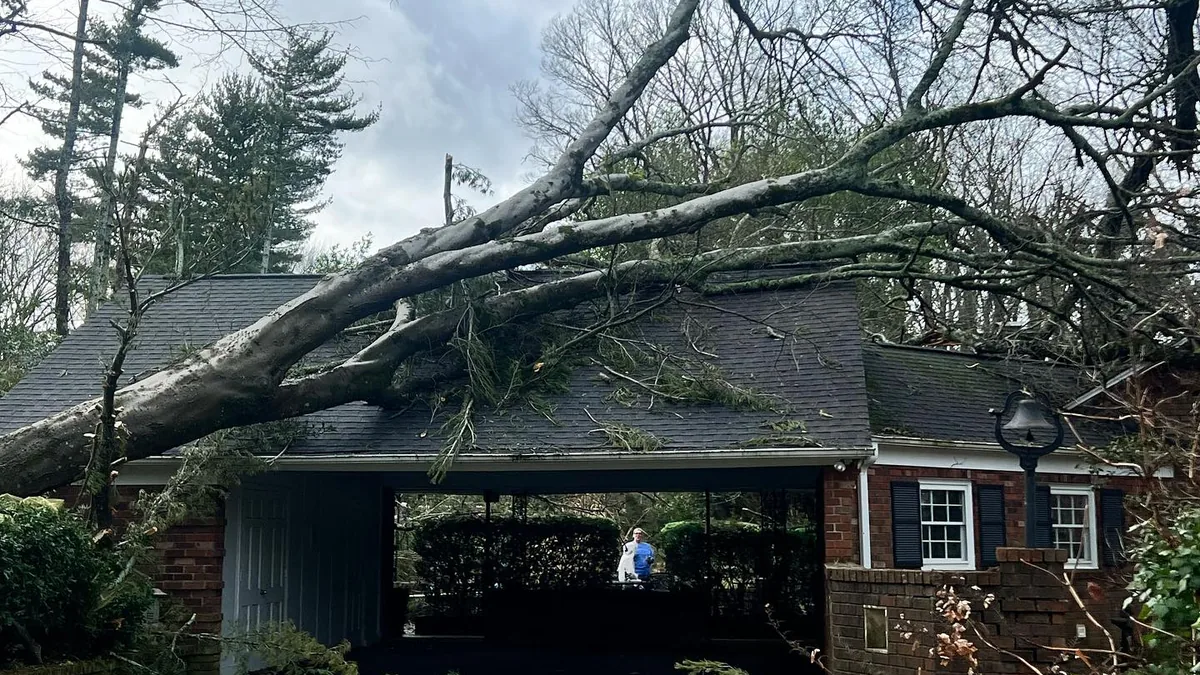
North Alabama gets its share of hard weather - spring storms, summer straight-line winds, the occasional ice event. And when a big tree comes down or ends up leaning on your house, it’s stressful and it’s easy to make a bad situation worse by rushing in.
Here’s the order we’d tell our own family to follow.
1. Make sure everyone’s safe - and stay back
First, get people and pets away from the tree and anything it’s touching. A tree that’s already fallen can still shift, and limbs under tension can snap and swing hard. Don’t walk under a leaning tree or a limb that’s hung up in the canopy to “see how bad it is.” It can wait.
2. Treat every downed line as live
If a tree took down a power line - or is resting on one - stay far away and assume the line is energized, even if the power looks out. Don’t touch the tree, the line, or anything they’re touching, and keep others back too. Call your utility to report it, and call 911 if there’s any immediate danger. No tree is worth a shortcut here, and we won’t touch a tree on a live line until the utility has cleared it either.
3. Check for immediate structural danger
If a tree is on your roof or has hit the house, look (from a safe distance) for obvious hazards - a sagging roofline, a tree that’s clearly still moving, gas smell, or damage near your electrical service. If anything seems unsafe, get everyone out and call for help. If it’s stable, you’ve got a little time to do the next step right.
4. Document it for insurance
Before anything gets moved, take photos and video - wide shots and close-ups of the tree, the damage, and anything it hit. Most homeowner policies cover tree damage to structures, and good documentation makes the claim go smoother. We can help here too: on storm and tree-on-structure jobs we document everything (before, during, and after) and itemize the work so your adjuster can process it without a lot of back-and-forth.
5. Call for the right kind of help
This is the point where a leaning or fallen tree needs a crew, not a homeowner with a chainsaw. Storm-damaged trees are under tension in ways that aren’t obvious, and cutting them in the wrong order is how people get hurt. A tree resting on a house has to be rigged and lowered in pieces - not just cut and dropped.
We answer storm and emergency calls as fast as the weather and crew allow, and for a tree on your home we bring the equipment to take it apart safely and protect what’s left standing.
What not to do
- Don’t climb up or onto the tree to cut it.
- Don’t try to cut a tree that’s leaning or bent - the tension can whip the trunk when it releases.
- Don’t assume a “little lean” is fine. A tree that’s shifted at the root has already told you something about its footing.
- Don’t wait days on a tree that’s on your house - every rain and gust can make it worse.
If a storm’s left you with a tree where it shouldn’t be, give us a call or send a photo. We’ll tell you honestly whether it’s an emergency or something that can wait a few days - and we’ll get there as quick as we can either way.
Got a tree you're not sure about?
We'll come take a look and give you a straight answer - free estimates across Cullman County and North-Central Alabama.